
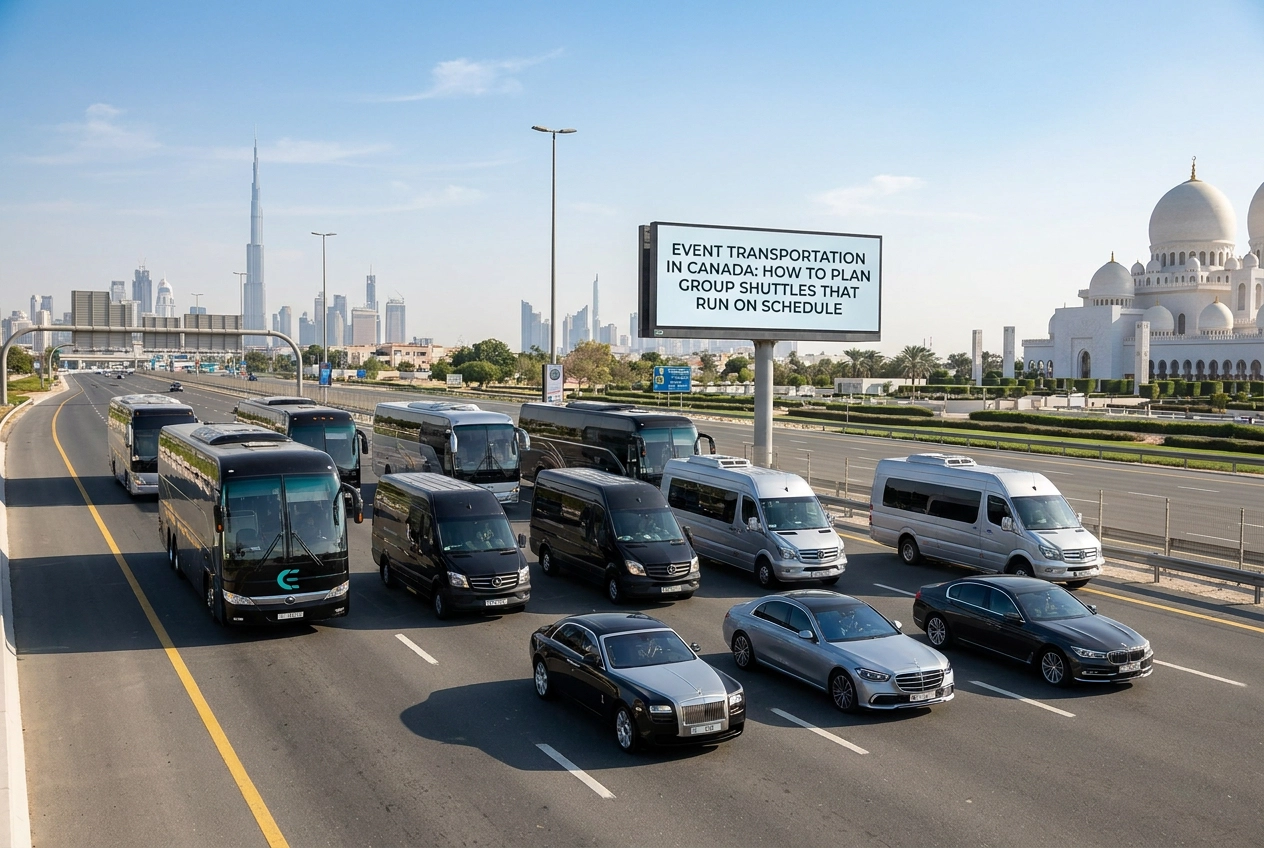

Shuttle logistics have ended more events than bad weather ever will. A delayed first departure creates a ripple effect that pushes dinner back forty minutes, compresses your program, and sends guests home frustrated before the evening hits its stride. Yet across Canada, event managers continue treating transportation as an afterthought, something to sort out after the venue, catering, and entertainment are locked in.
That approach is expensive. Whether you are coordinating a party bus rental for a corporate milestone, managing multi-point pickup routes for a gala, or moving hundreds of conference delegates between venues on a tight schedule, the same operational gaps cause the same failures: under-allocated vehicles, routes without timing buffers, and no contingency plan when something goes sideways.
This guide gives you a repeatable framework to eliminate transportation as a day-of risk. You will learn how to map guest volumes accurately, allocate the right vehicles, design shuttle routes with built-in buffers, and vet providers who actually deliver on schedule. From VIP and accessible guest protocols to sustainability considerations, every section is built for the event professional who needs practical systems, not general advice.
While the operational principles here apply wherever you are coordinating group transport, GetRide’s own event transportation expertise is built on UAE and global operations. Canadian event planners should verify local regulatory details with provincial transport authorities.
Why Shuttle Logistics Make or Break Guest Experience
Good event logistics follow a principle that experienced planners learn the hard way: when everything works, nobody notices. Guests board a shuttle at the hotel, arrive at the venue with time to settle, and move through the evening without friction. The transport becomes invisible, exactly as it should. What guests remember, without exception, is the shuttle that was late, the one that never showed, or the 40-minute wait in a January parking lot in Ottawa.
That invisibility standard is why ground transportation carries disproportionate risk. A catering delay is visible and recoverable. A shuttle failure is felt by every guest simultaneously, before the event has even started.
Poor transport planning is the most common cause of delayed event openings, even at events where the venue, catering, AV, and programming have been handled with care. The logistics failure frequently has nothing to do with ambition or budget; it comes from under-planning the movement of people.
One blind spot appears repeatedly: speakers and VIPs are left to self-arrange. Planners focus on general attendee shuttles and assume senior guests will manage their own arrivals. In practice, a keynote speaker navigating an unfamiliar Canadian city during rush hour, without a confirmed pickup, produces exactly the kind of last-minute scrambling that a structured transport plan eliminates entirely. Matching the right vehicle category to the right guest tier matters as much for a corporate event as it does when thinking through different bus service formats for varied passenger needs.
The cascade effect compounds every delay. A shuttle running 20 minutes behind does not just inconvenience its passengers; it pushes the welcome remarks, compresses the first session, shortens the networking break, and forces the catering team to hold or rush service. One transport failure restructures the entire program.
Finally, reliable transportation communicates something before the agenda begins. Guests who arrive smoothly, on time, in a clean and well-organized vehicle form an immediate impression of operational competence. That impression shapes how they receive everything that follows.
What to Confirm Before You Start Planning
Before a single provider is contacted or a route is mapped, five facts need to be locked in. Skipping any one of them forces decisions based on assumptions, and assumptions are what cause shuttle logistics to unravel on event day.
Confirm a guest headcount range first. A precise final number is not required at the planning stage; a rough estimate within a reasonable margin is enough to begin vehicle allocation calculations. What is not workable is no number at all. Even a working range of 80 to 100 guests produces actionable logistics. A blank field produces nothing.
Get the venue’s access rules in writing. Canadian conference centres, hotel properties, and outdoor event sites routinely have designated coach drop-off zones, load restrictions on entrance driveways, and timed access windows that the venue operations team controls. These constraints directly shape your routing options. A shuttle bus that cannot legally enter a driveway at the scheduled arrival time is not a routing problem; it is a planning gap that should have been resolved weeks earlier.
Map every origin point, not just the headquarters hotel. Guests may be departing from multiple hotel blocks, a main airport terminal, regional transit hubs, or private residential addresses for VIPs. Each distinct origin point requires its own pickup logistics. Treating the event as a single-origin operation is one of the most common planning errors for multi-day conferences.
Assess accessibility requirements early. Under the Accessible Canada Act, federally regulated organizations must address transportation barriers, and applicable provincial regulations extend similar obligations across many event contexts. Accessible vehicles with ramps, lifts, and securement systems are limited in supply in most Canadian cities, particularly during peak spring and fall conference seasons. Confirm availability with providers before the calendar fills up.
Set a budget ceiling before approaching vendors. Shuttle bus rental pricing in Canada averages approximately $1,000 CAD for 35 to 40 guests on a 15 to 20-minute route (per industry benchmarking). Having a defined range prevents scope creep during vendor conversations and allows meaningful comparison across quotes. Providers approached without a budget ceiling will size their proposals to fill whatever space they are given.
With these five inputs confirmed, the vehicle allocation and routing work covered in the next section becomes straightforward rather than speculative.
Guest Volume Mapping and Vehicle Allocation
Once your prerequisites are locked, apply your headcount estimate directly to a vehicle allocation model. The scale of your event determines the vehicle category; everything else flows from there.
Under 50 guests: A single minibus, a pair of SUVs, or luxury sedans cover the load comfortably. For social events, a party bus rental is worth considering here, since the vehicle itself becomes part of the guest experience rather than simply a transfer mechanism.
50 to 150 guests: Mini-coaches are the right tool. Rather than deploying two vehicles simultaneously, run a single mini-coach on staggered departure windows. One vehicle completing multiple loops is more cost-effective than two vehicles sitting idle between runs, provided your venue timeline has the flexibility to absorb the cycle time.
150 or more guests: This scale requires full-size charter bus rental operating on a continuous loop. Use roughly one full-size coach per departure wave for every large cohort of guests (a widely used rule of thumb among event logistics planners, not a regulatory standard) as your opening allocation. If your registration data confirms staggered arrivals spread across two or more hours, adjust that number downward; concentrated arrivals within a tight window demand the full figure.
Apply a Safety Buffer
Never finalise vehicle allocation at exactly the seat count your math produces. Add a safety buffer, a common planning heuristic, above your calculated seat count before confirming with your provider. A last-minute RSVP spike, carry-on luggage volume, or an unexpected plus-one will push you past capacity on at least one run if you have no margin built in.
Segment Your Guest List Before Booking
General attendees and VIPs are not the same transport category. VIP and speaker vehicle requirements are covered separately in the dedicated section below. If you are evaluating vehicle formats across guest tiers, a review of van hire options, sizing, and pricing provides useful context for matching vehicle class to guest type before you finalise your provider brief.
Shuttle Route Design and Timing Buffers
Once your vehicle counts are confirmed, routing and scheduling determine whether those vehicles actually deliver guests on time.
Map every route segment before you contact a provider. Use Google Maps, Waze, or Apple Maps set to your exact event day and departure time, not a Tuesday at 2 p.m. when your event runs on a Friday evening. Major urban corridors across Canadian cities have congestion windows that vary sharply by day of week. The drive time you see at off-peak is not the drive time your driver will experience.
Apply a meaningful time buffer, industry practitioners commonly use figures in the range of 15–25%, to every mapped segment. A 15-minute mapped route might be scheduled for 18–20 minutes as a working example of that buffer in practice. The buffer absorbs boarding delays, minor traffic variance, and venue access queues. It is not padding; it is the difference between a schedule that holds and one that collapses by the third run.
Establish a firm boarding cutoff, five minutes before scheduled departure is a practical convention. A guest who arrives at the boarding point after the door closes gets directed to the next scheduled run. Holding the shuttle for late arrivals shifts every subsequent departure, and that compression accelerates through the full route cycle. A firm boarding close is a protection for every other guest who arrived on time. For context on how transit schedules handle this in the Greater Toronto Area, the Highway 407 Bus Terminal: Routes, Schedules and Connections guide illustrates how fixed departure windows operate across a multi-route terminal environment.
A widely used convention is to target final arrival at least 15 minutes before any hard-start moment. If your keynote begins at 7:00 p.m., the last shuttle must be at the venue well before that. Guests need time to clear the vehicle, move through venue entry, and be seated. Plan to that reality.
Loop routes need a confirmed holding point. Your driver must be able to stage at the turnaround without blocking venue traffic flow. Confirm this directly with the venue operations team, not only the event coordinator. Venue ops controls physical access and can override informal arrangements made during planning calls.
Put everything in a single written transport brief. Every route, stop address, scheduled departure time, and passenger count belongs in one document shared with the provider, every driver, and your on-site coordinator before event day. Verbal agreements on timing do not survive the pressures of the day.
Contingency Vehicle Protocols That Prevent Day-Of Collapse
Tight routing and timing buffers get your shuttles to the venue on schedule. Contingency protocols are what keep them there when something goes wrong.
For larger events, generally those with over a hundred guests, plan for at least one standby vehicle that carries no scheduled route assignment. This vehicle exists solely to replace a primary unit if a driver does not report or a mechanical issue pulls a coach off rotation. Clarify the response window in your contract; providers should be able to commit to a specific timeframe. Beyond that window, your program schedule absorbs the delay.
Get the breakdown protocol in writing before you sign anything. Ask your provider three specific questions: what is their vehicle replacement process, what is their guaranteed response time, and which named staff member do you contact when something fails. A phone number routed to a general dispatch queue is not an answer. You need a named person with decision-making authority who is reachable for the full duration of your event.
Canadian winter events require a separate layer of contingency planning that most planners skip entirely. Before confirming any provider for a November through March event, confirm in writing that their fleet is winterized, that assigned drivers hold current training for winter road conditions, and that there is a defined threshold at which routes are cancelled or rerouted during a weather event. Planners who skip this conversation discover the hard way what unplanned cancellations actually cost, in both logistics and guest trust.
Build a soft close into your return shuttle schedule. The final departure should leave no earlier than 30 minutes after the official event end time. Networking consistently runs past scheduled close, and the exit flow through coat check, elevators, and venue egress is slower than planners anticipate. A last shuttle that leaves on the dot strands guests.
Finally, designate one person on your event team as the sole transport contact for the day. When two coordinators give conflicting instructions to a driver or dispatcher, the response slows while the provider waits for a clear directive. One contact, one voice, no ambiguity.
Planning VIP, Speaker, and Accessible Guest Transport Separately
Beyond contingency protocols, a separate category of planning failure affects VIPs, speakers, and guests with accessibility needs. These three groups share one thing in common: standard shuttle logistics do not work for them, and treating them as part of the general attendee pool creates predictable, avoidable problems.
Treat VIP and speaker transport as a parallel logistics track. This means dedicated vehicles, assigned drivers, separate scheduling documents, and one point of contact who manages only this segment.
Speaker pickups carry specific requirements that standard shuttle bus rental vehicles rarely meet. Speakers arriving from airports often travel with presentation equipment, display materials, and checked luggage. Their vehicle needs adequate cargo space, and their driver must be authorized to wait beyond the scheduled pickup window if a flight is delayed. Assign confirmed flight tracking to the VIP coordinator so the driver receives updated arrival times rather than waiting blind at departures.
Accessible transport requires its own vehicle specifications and schedule adjustments. Vehicles must be equipped with ramps or lifts and mobility device securement systems. Boarding an accessible vehicle adds meaningful additional time per stop, so every accessible shuttle run needs that time built in explicitly. Do not absorb it from timing buffers intended for traffic variance.
Book accessible vehicles as early as possible, supply is limited in most major Canadian cities, particularly during peak conference periods. Waiting until standard vehicle bookings are confirmed is a common mistake that leaves accessible guests without compliant transport.
Do not rely on your registration form to capture full mobility requirements. A brief pre-event confirmation call to guests who indicated accessibility needs surfaces requirements that online forms routinely miss, including specific device dimensions, transfer assistance preferences, and pickup timing constraints. That call eliminates surprises on the day.
Building a Driver-Organizer Communication Framework
With segment-specific logistics handled for VIPs and accessible guests, the final coordination layer that determines whether all that planning actually executes is communication between your drivers and your on-site team.
Issue written transport briefs well in advance of the event, at minimum the day before. Every assigned driver receives a document covering their route, all stop addresses with GPS coordinates, scheduled departure times, passenger counts per run, and the direct mobile number of your on-site coordinator. A verbal briefing on the morning of the event is not a substitute; it leaves no record and cannot be referenced mid-run when a driver is uncertain about a stop sequence.
Require a pre-departure check-in with enough lead time to act on any problem discovered, one hour before first departure is a practical minimum. Before the first scheduled shuttle departure, each driver confirms vehicle readiness and their physical location to your coordinator. This window exists specifically so you can escalate to a contingency vehicle if something is wrong. A problem discovered at departure time cannot be solved; one discovered earlier usually can.
Adopt a traffic-light status system for day-of communication.
- Green: run is on schedule
- Yellow: delay under 10 minutes, no intervention needed
- Red: problem requiring coordinator action
This keeps radio and message traffic concise. Drivers report a colour; coordinators know immediately whether to act. Lengthy status updates during active operations create confusion and slow response times.
Post a loading coordinator at each major pickup point. This person controls boarding, closes the door at departure time regardless of stragglers, and reports the confirmed passenger count to the on-site coordinator after each departure. On events running multiple simultaneous shuttle routes, this role is the difference between accurate tracking and guesswork.
Debrief with your provider within a day or two of the event. Document which runs executed on schedule, where delays occurred, and what caused them. This record has two functions: it feeds directly into your vehicle allocation and timing buffer calculations for future events, and it gives you documented grounds to request a service credit if performance fell short of what was contracted.
Maintaining one named transport contact, as established in the contingency section, is the communication backbone that makes all of the above work.
How to Vet a Reliable Event Transport Provider
A well-built communication framework only protects you if the provider on the other end is capable of executing it. Before any contract is signed, run every candidate through the same five checks.
Credentials first. A credible provider should produce three documents without hesitation: a current provincial operating licence, proof of commercial vehicle insurance, and a reference list of comparable events serviced in the past 12 months. If retrieving any of these requires follow-up calls or vague explanations, that is your answer.
Confirm that the dedicated operations contact you identified during vetting will be reachable throughout your event, not routed through a general dispatch queue.
Get everything in writing. A proper service agreement specifies vehicle type, seating capacity, driver count, scheduled routes, departure times, contingency vehicle terms, and the remedy if they fail to deliver. Providers who push back on documenting operational specifics are telling you they do not intend to be held to them. This is also where understanding the difference between event-specific contracts and broader corporate transport arrangements matters; the former must be far more granular.
Inspect the fleet. Clean interiors, functioning climate control, and current maintenance records are baseline requirements, not premium upgrades. Ask when each assigned vehicle was last serviced and request a pre-event inspection. A provider confident in their fleet will accommodate this without resistance.
Verify driver qualifications for corporate events. Confirm that drivers hold current commercial licences for the vehicle class they will operate, have passed background checks, and have direct experience with event-specific routing. Running a timed shuttle loop at a multi-hundred-person conference demands different skills than a standard point-to-point transfer; not every driver has both, and the distinction matters on a day when timing tolerance is measured in minutes.
Sustainability Considerations for Canadian Event Transport
Vetting your provider covers operational competence. Sustainability asks a different question: what is the environmental cost of moving your guests, and are you actively reducing it?
Attendee travel is typically the single largest carbon footprint contributor for any event. The most impactful step you can take is consolidating guests onto shuttle bus routes rather than defaulting to individual vehicle trips. One full-size coach replacing 40 separate car journeys eliminates roughly 39 combustion trips from your event’s footprint. The math is straightforward; the discipline to enforce it is the harder part.
Venue selection is where the leverage is highest. Choosing a venue within walking distance of a major transit hub can reduce an event’s transportation carbon footprint substantially for large gatherings, because a significant share of attendees will arrive by rail or bus without any chartered vehicle required. Treat transit proximity as a weighted venue evaluation criterion alongside cost and capacity, not a secondary consideration noted after the contract is signed.
Canadian corporate events are increasingly subject to ESG reporting obligations, and transportation vendors are part of that picture. When evaluating providers, ask directly whether they can supply fuel consumption data, vehicle emissions specifications, or carbon offset documentation. If your post-event sustainability report needs verified transport figures, a provider who cannot produce them is an operational gap.
Fleet right-sizing is both a cost and emissions measure. Over-ordering vehicles that run half-empty doubles your fuel consumption per passenger without improving service. A provider who actively helps you match vehicle allocation to confirmed passenger demand is contributing to your sustainability outcomes, not just filling a contract.
Some Canadian providers now bundle event transportation with route optimisation software and emissions reporting as part of their service offering. For organisations with formal ESG commitments, these programs are worth evaluating even at a modest cost premium. The reporting infrastructure alone can offset the premium by eliminating post-event data collection work.
Your Repeatable Event Transport Planning Checklist
With the operational and sustainability framework in place, use this checklist as your pre-event quality gate. Run through each item for every event, regardless of scale.
Before you contact any provider:
- Confirm a guest headcount range sufficient to begin vehicle allocation calculations (planning heuristic: a rough estimate within a reasonable margin is workable; no number at all is not)
- Document every origin point: hotel blocks, airport terminals, VIP addresses
- Obtain venue access rules in writing, including coach drop-off zones and timed entry windows
- Determine accessible vehicle requirements under applicable federal and provincial regulations
Vehicle allocation (see “Guest Volume Mapping and Vehicle Allocation” for the full allocation model):
- Size coach selection to your guest cohort and departure wave structure, using the allocation guidance in the vehicle mapping section as your starting point
- Add a safety buffer above your calculated seat count (planning heuristic: a commonly used margin accounts for late RSVPs, luggage, and plus-ones)
- For larger events, contract at least one contingency vehicle held off scheduled routes, with a response timeframe confirmed in writing
Timing (see “Shuttle Route Design and Timing Buffers” for the full approach):
- Apply a meaningful time buffer to every mapped route segment; industry practitioners commonly reference a range of 15–25% (planning heuristic)
- Target final shuttle arrival well before any hard-start program moment, with enough time for guests to clear the vehicle and be seated
Separate logistics tracks:
- VIP, speaker, and accessible guests each require dedicated vehicles, named drivers, and a coordinator responsible solely for that segment
- Do not fold these into the general attendee shuttle pool; they have incompatible scheduling requirements
Provider vetting (see “How to Vet a Reliable Event Transport Provider” for the full criteria):
- Confirm credentials, written service agreement, fleet condition, and driver qualifications as detailed in the vetting section
Post-event close (see “Building a Driver-Organizer Communication Framework” for the full debrief process):
- Debrief with your provider within a day or two of the event, document schedule performance, and store the record as your baseline for the next event
Reliable event transportation is not a function of luck or a provider’s general reputation. It is the output of a defined planning process applied consistently. This checklist condenses that process into a repeatable framework you can apply from the first planning meeting through the final shuttle run.
Conclusion
Shuttle logistics are not a secondary detail; they are a direct reflection of how well your event respects attendees’ time. The planners who consistently deliver smooth transportation apply the framework in this guide at every event, and refine it after each debrief.
Start with the checklist on your next event. Identify the one or two gaps in your current process and close them before the booking conversation begins. That disciplined preparation is what separates transportation that enhances the guest experience from transportation that quietly undermines it.