

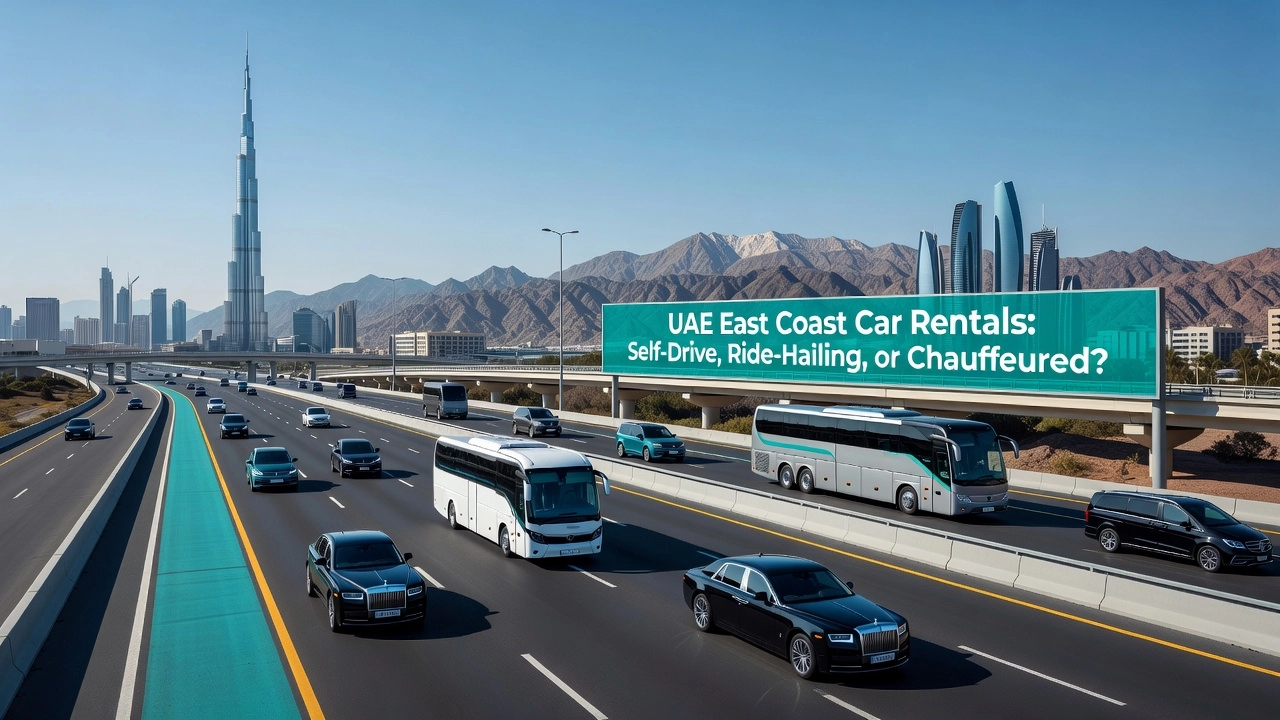

Picture this: you’ve just landed in the UAE, ready to explore the stunning east coast, with its turquoise waters, rugged Hajar Mountains, and charming coastal towns. But then it hits you. How exactly are you going to get around?
This is where east coast car rentals become your best friend, but here’s the thing, there are actually a few different ways to rent or hire a car in this part of the UAE. You can take the wheel yourself with a self-drive rental, tap an app and let a ride-hailing driver do the work, or go all out with a chauffeured service that treats you like royalty.
Each option has its own perks, price points, and ideal use cases, and choosing the wrong one can seriously affect your trip. In this guide, we’re breaking down all three choices in plain, simple terms so you can figure out which one suits your travel style and budget best. By the end, you’ll know exactly which option to book before your east coast adventure begins.
What Is the UAE East Coast? Defining the Region First
If you have spent time planning a UAE trip, you have probably heard a lot about Dubai and Abu Dhabi. But there is a whole other side to the Emirates that many first-time visitors simply do not know about. The UAE East Coast stretches along the Gulf of Oman and covers some genuinely stunning territory, including Fujairah, Khor Fakkan, Dibba, and parts of Ras Al Khaimah. Hatta is also frequently included in East Coast road trip itineraries, though it is technically an inland enclave of Dubai emirate nestled in the Hajar Mountains rather than a formal part of Fujairah.
This corridor is growing fast as a travel destination. You will find beach resorts, wadi trails, mountain hikes, ancient forts, and even major industrial free zones all packed into a relatively short stretch of coastline. It draws leisure visitors from Dubai and Abu Dhabi on weekends, and corporate travellers heading to Fujairah Port throughout the week.
Here is something that surprises most newcomers: unlike Dubai or Abu Dhabi, the East Coast has no metro lines and no reliable intercity bus network. That single fact changes everything about how you need to plan your trip. Private transport is not just convenient here; it is practically the only realistic option. Real travellers in Dubai planning the drive to Khor Fakkan and Fujairah regularly ask about rental options because there simply is no scheduled alternative.
The distances involved are also worth understanding before you book anything. Dubai to Fujairah city is roughly 130 kilometres, and Dubai to Dibba is closer to 200 kilometres. Roads range from smooth dual carriageways to winding mountain passes through the Hajar range, so your vehicle choice and driver experience genuinely matter here.
On the market side, the Middle East car rental sector is valued at USD 3.41 billion in 2026 and is projected to climb to USD 4.47 billion by 2031, with tourism growth and digital adoption identified as the two biggest drivers. Both of those factors are playing out directly along the East Coast corridor right now, making this region one of the most relevant growth areas for anyone thinking about transport options in the UAE.
Option 1: Self-Drive Car Rental from International Chains
The most familiar option for most travellers is picking up a self-drive vehicle from one of the international rental chains. These brands operate at UAE airports and major city locations, offering everything from compact economy cars to premium SUVs. Globally, the top five players collectively held 52.2% of the global car rental market in 2025, which gives you a sense of how dominant these names are. However, their physical footprint on the UAE East Coast is much thinner than you might expect. Enterprise does maintain a Fujairah location, and a handful of other providers operate in the city, but coverage beyond Fujairah itself is limited. Towns like Khor Fakkan and Dibba are largely unserved by major international chains.
Self-drive works well if you already know the UAE road network, hold a valid UAE driving licence, and feel confident navigating mountain roads and rural coastal highways without any backup. The East Coast route from Dubai takes you through Sharjah and eventually into winding stretches near the Al Hajar Mountains, which are genuinely beautiful but require attentive driving, especially if you are unfamiliar with the terrain.
For tourists, the licencing rules add real complexity. Visitors from many countries need an International Driving Permit alongside their national licence before they can legally drive in the UAE. This requirement applies across all emirates, including Fujairah, but international chains do not always spell it out clearly during the online booking process. The standard minimum rental age is 21 years, rising to 25 for luxury vehicles and SUVs, and provisional licences are not accepted by most agencies.
One-way rentals and East Coast drop-offs are another practical gap worth understanding before you book. Most providers require you to return the vehicle to the original pickup location, which creates real inconvenience for multi-stop itineraries across Fujairah, Khor Fakkan, and Dibba. You should also budget for hidden costs including toll charges, potential mileage caps, and insurance upgrades.
Regional providers like Autostrad in Fujairah do offer alternatives to the global chains, and prices from aggregators start around $21 per day for basic vehicles. Still, self-drive as a category suits a fairly specific traveller, someone with UAE driving experience, the right paperwork sorted in advance, and a flexible itinerary. For tourists, corporate groups, families, or anyone planning a structured point-to-point journey from Dubai to the East Coast, the self-drive model leaves meaningful gaps that a professionally managed transport service is much better positioned to fill.
Option 2: Using Ride-Hailing Apps for UAE East Coast Trips
Ride-hailing apps are genuinely useful for getting around Dubai or Sharjah, but they run into real problems the moment your destination moves toward the East Coast. Driver availability is built around short, high-turnover urban trips. Once your route extends past the city limits toward Fujairah, Khor Fakkan, or Dibba, the number of available drivers drops significantly. The app algorithms are simply not designed for 120 to 150 km intercity journeys, and you may find yourself waiting far longer than expected, or not getting a match at all.
Pricing is another issue worth taking seriously. Peak travel times on Friday and Saturday mornings, when residents head to Fujairah beaches, are exactly when surge pricing kicks in. What might look like a reasonable fare on a Tuesday afternoon can become an unpredictable expense by the time the weekend rolls around. For anyone trying to budget a trip in advance, that kind of variability is frustrating. According to Middle East ride-hailing market research covering 2025 to 2030, UAE coverage remains concentrated in Dubai and Abu Dhabi, with intercity routes representing a clear gap in reliable service.
Corporate clients, school groups, and event organisers face an even more specific problem. Standard ride-hailing apps do not support fixed departure times, corporate invoicing, or coordinating multiple vehicles for a group. These are non-negotiable requirements for organised travel, and apps simply were not built to handle them. Market research on ride-hailing segments confirms that corporate transport is treated as a distinct category with needs that consumer apps leave largely unmet.
Then there is the return trip problem. If you book a one-way ride to somewhere remote like Hatta or Dibba, finding a return ride through an app is genuinely unreliable. Drivers have little incentive to position themselves in low-demand areas, which means passengers can find themselves stranded in spots with poor coverage and few options. Ride-hailing apps serve a clear purpose for short city trips, but East Coast journeys require planning, reliability, and flexibility that this model was never designed to deliver.
Option 3: Chauffeured Transport with GetRide
This is where GetRide steps in to fill the gap that both previous options leave open. While self-drive rentals put the navigation burden on you and ride-hailing apps struggle beyond urban boundaries, GetRide operates dedicated chauffeured transport across the exact corridor we have been discussing: Fujairah, Ras Al Khaimah, Sharjah, Hatta, and the coastal stretches in between.
And this approach is not a niche preference anymore. According to the UAE Chauffeur Car Market research, managed and chauffeur-driven transport is a growing segment across the region, with visitors and corporate clients increasingly choosing professional driver services over handling the wheel themselves. The Middle East limousine and chauffeured services market reflects the same shift, pointing to rising demand for accountable, pre-booked transport solutions. This is simply how more people in the region are choosing to travel now.
What makes GetRide’s approach genuinely practical is the route knowledge its drivers bring. The Dubai-to-Fujairah run covers roughly 130 kilometres through the E611 and E102 highways, taking approximately 90 to 120 minutes depending on traffic. The Hatta mountain road involves winding sections and shifting speed zones that can genuinely catch unfamiliar drivers off guard. GetRide’s drivers know these roads, the timing patterns around holiday weekends, and the fastest routing through the Masafi junction. That local knowledge translates directly into punctual arrivals and calmer journeys.
The service is built to work for several different types of travellers. Tourists get door-to-door transfers without worrying about foreign licence requirements or unfamiliar road signs. UAE residents heading to Fujairah beaches or the Hatta dam on a weekend can simply sit back instead of driving a long return journey after a full day outdoors. Corporate clients get scheduled, accountable transport for staff or guests attending East Coast business sites and resort events.
The practical advantages over the previous two options are straightforward. Fixed pricing removes the surge-pricing uncertainty that on-demand apps introduce on long routes. Advance booking guarantees confirmed availability rather than hoping a driver accepts your request outside a major city. Corporate invoicing supports expense reporting properly. And a well-maintained fleet removes the mechanical risk that comes with driving a self-hire vehicle on mountain terrain.
UAE East Coast Roads: What to Expect Route by Route
Knowing what each road actually looks like before you set off makes a real difference to how your journey feels. Here is what to expect, route by route.
Dubai to Fujairah via the E611
The Dubai to Fujairah highway is a well-maintained dual carriageway and, on a quiet day, a genuinely pleasant drive of around two hours. The problem is that Friday mornings are rarely quiet. Weekend traffic builds quickly as Dubai residents head east, and the E611 becomes a slow crawl if you leave at the wrong time. Departing before 7am or after midday on a Friday changes the experience entirely. A driver who knows these timing patterns, and which minor route adjustments help avoid the worst pinch points, turns a potential headache into a smooth run.
The Hatta Mountain Road
The road through the Hajar Mountains toward Hatta involves a series of winding ascents and descents that feel quite different from flat highway driving. The Hajar range rises to 1,527 metres at Jebel Yibir, and the roads reflect that terrain. In clear conditions, it is manageable but demanding. During rainfall, which is rare but does happen, road surfaces lose traction quickly on mountain curves. First-time drivers on this stretch often underestimate how much concentration it requires, particularly on the descent sections where speed can build unexpectedly.
The Khor Fakkan Coastal Drive
The new Dh6 billion, 89-kilometre road linking Sharjah to Khor Fakkan has cut journey time from 90 minutes to 45 minutes, which is genuinely impressive infrastructure. However, the route passes through five tunnels and involves sharp mountain transitions that catch unfamiliar drivers off guard. Beyond the new road, older coastal stretches toward Khor Fakkan still feature narrow bends with limited overtaking space. Underestimating journey time on this corridor is a common mistake for first-time visitors, as described in this East Coast guide from Rough Guides.
Dibba and the Northern Border Point
Dibba sits at the northernmost tip of the UAE East Coast, and reaching it adds a logistical layer that the other routes do not have. Depending on your origin point, you may encounter a border crossing into Omani-administered territory. A local driver handles this automatically, knowing exactly which route to take and what documentation applies. A self-drive renter needs to research this independently before departure, including whether their rental agreement permits driving in border-adjacent zones.
Route knowledge on the UAE East Coast is not a bonus feature; it is a practical safety factor. The difference between a well-planned trip and a stressful one often comes down to knowing the road before you are already on it.
Tourists, Residents, and Corporate Clients: Different Needs, One Solution
Not every traveller heading to the UAE East Coast has the same priorities, and that is actually the most important thing to understand before choosing how to get there.
First-Time Tourists
If you are visiting Fujairah or Khor Fakkan for the first time, a chauffeured vehicle removes practically every friction point in one go. You do not need to worry about whether your international driving licence is accepted for self-drive rentals in the UAE. You do not need to navigate unfamiliar mountain roads, locate wadi entry points, or hunt for parking at busy beach resorts. Your driver already knows where to go, and many experienced chauffeurs will casually point out local spots worth visiting along the way. That kind of local knowledge is genuinely difficult to replicate with a GPS app.
UAE Residents on Weekend Trips
Residents travelling from Dubai or Abu Dhabi face a different problem. The drive to Fujairah typically takes between 90 minutes and two hours each way, and doing that round trip on a Friday means someone in the group has to stay off the beach, skip the sunset, and drive home tired. A shared chauffeured vehicle means everyone arrives refreshed, no one gets stuck as the designated driver, and the return journey is already sorted before you even leave home.
Corporate Clients and Event Organisers
For corporate clients, reliability is non-negotiable. A missed staff shuttle or a late client pickup at an East Coast project site or entertainment venue carries real business costs, and no ride-hailing app can be held accountable for that. Event organisers coordinating beach weddings, team-building retreats, or group cultural tours need multi-vehicle scheduling, consistent arrival times, and a single point of contact to manage everything.
The flexibility to book a one-way trip with a scheduled return is something neither self-drive drop-off policies nor ride-hailing apps reliably offer. With GetRide, that structure is simply how the service works.
When to Book: Seasonal Demand on the UAE East Coast
Timing your transport booking well is just as important as choosing the right type of service. The UAE East Coast follows a very clear seasonal pattern, and understanding it will save you from the frustrating experience of arriving in Fujairah or Khor Fakkan without a confirmed ride.
October through April is the window when everyone wants to be on the East Coast. Temperatures drop to a comfortable range, the beaches are genuinely enjoyable, and routes through the Hajar Mountains become a pleasure rather than an endurance test. This is peak demand season, and transport availability tightens across every option. If you are planning a trip during these months, treat your transport booking the same way you treat your hotel booking: sort it early.
Public holidays make the pressure even sharper. National Day, Eid Al Fitr, Eid Al Adha, and the New Year period all create concentrated bursts of demand on the Dubai-to-Fujairah route. The highway fills up, and available vehicles and drivers get snapped up quickly. Booking at least 48 to 72 hours in advance is a sensible minimum during these windows, especially for group travel or multi-vehicle requirements.
Summer is a different story for leisure travel. June through August see far fewer tourists heading to the East Coast, and if you are flexible on timing, this period offers quieter roads and more transport availability. That said, Fujairah’s industrial and port activity runs year-round, so corporate and staff transport demand stays consistent regardless of the season.
One practical tip that often gets overlooked: book your transport at the same time you book your accommodation. Securing a hotel in Khor Fakkan and then searching for transport as an afterthought is a recipe for stress. GetRide allows you to plan both together, giving your trip a much more solid foundation from the start.
How to Book Your UAE East Coast Transport with GetRide
Booking your UAE East Coast transport with GetRide is straightforward, and the more detail you share upfront, the smoother the whole process goes. When you reach out, have your pickup location ready, along with your destination, travel date, group size, and any specific requirements like extra luggage space, child seats, or corporate invoicing. Providing these details at the start means GetRide can give you a faster, more accurate quote without the back-and-forth that slows things down.
Coverage is broad. GetRide serves all the primary UAE East Coast destinations, including Fujairah, Khor Fakkan, Hatta, Ras Al Khaimah, and Dibba. Both the Dubai-to-East Coast and Abu Dhabi-to-East Coast routes are fully covered, so wherever you are starting from, the journey is taken care of.
One of the clearest practical benefits is fixed pricing. The figure quoted at booking is exactly what you pay at journey end. No surge multipliers, no unexpected toll additions, and no last-minute surprises when you are trying to manage a group trip budget. That kind of certainty is genuinely useful, especially for organised group travel or company outings.
For businesses with recurring transport needs, such as regular staff shuttles to Fujairah facilities or port operations, GetRide offers customised travel solutions with flexible scheduling and dedicated account management. Corporate clients get a consistent, managed service rather than rebooking from scratch each time.
To get started, simply request a quote through the GetRide website. The process is no-obligation and takes under two minutes, giving you a journey-specific price rather than a generic daily rate.
The Smarter Way to Travel the UAE East Coast
By now, you have seen all three options laid out clearly. Self-drive rental works well if you are a confident, licensed driver who knows UAE roads and wants full control over your itinerary. Ride-hailing apps are a solid choice for short urban trips within Dubai or Sharjah, but they fall apart on longer East Coast journeys where driver availability is thin and surge pricing makes costs unpredictable. Chauffeured transport, on the other hand, covers everything the other two options cannot: fixed pricing, local route knowledge, flexible waiting time, and a professional driver handling every kilometre while you actually enjoy the scenery.
The UAE East Coast is growing fast as a travel destination, and that growth is outpacing what international rental chains and generic app platforms can realistically serve. As highlighted in UAE car rental market shifts for 2026, tourism growth and changing mobility preferences are reshaping what travellers expect, and local specialists are best positioned to meet that demand. Big chains focus on airport hubs; apps focus on city centres. Neither was built for Khor Fakkan or Dibba.
The single takeaway here is simple: the best East Coast journey starts with a transport plan, not an afterthought. Peak season runs October to April, and availability tightens quickly. Get a quote for your East Coast journey through GetRide and book ahead before your dates fill up.
Conclusion
The UAE East Coast is one of the region’s most rewarding destinations, and getting your transport right makes all the difference. Here is a quick recap of what you need to remember:
- Self-drive rentals offer freedom and flexibility for independent explorers
- Ride-hailing apps work best for short, casual trips without the commitment
- Chauffeured services deliver comfort and convenience for special occasions or business travel
- Your budget, group size, and itinerary should guide your final decision
No single option suits every traveler, but now you have everything you need to make a confident, informed choice. Whether you are chasing mountain viewpoints or hopping between coastal towns, the right vehicle arrangement turns a good trip into an unforgettable one.
Ready to hit the road? Start comparing east coast car rental options today and book early to secure the best rates for your adventure.