

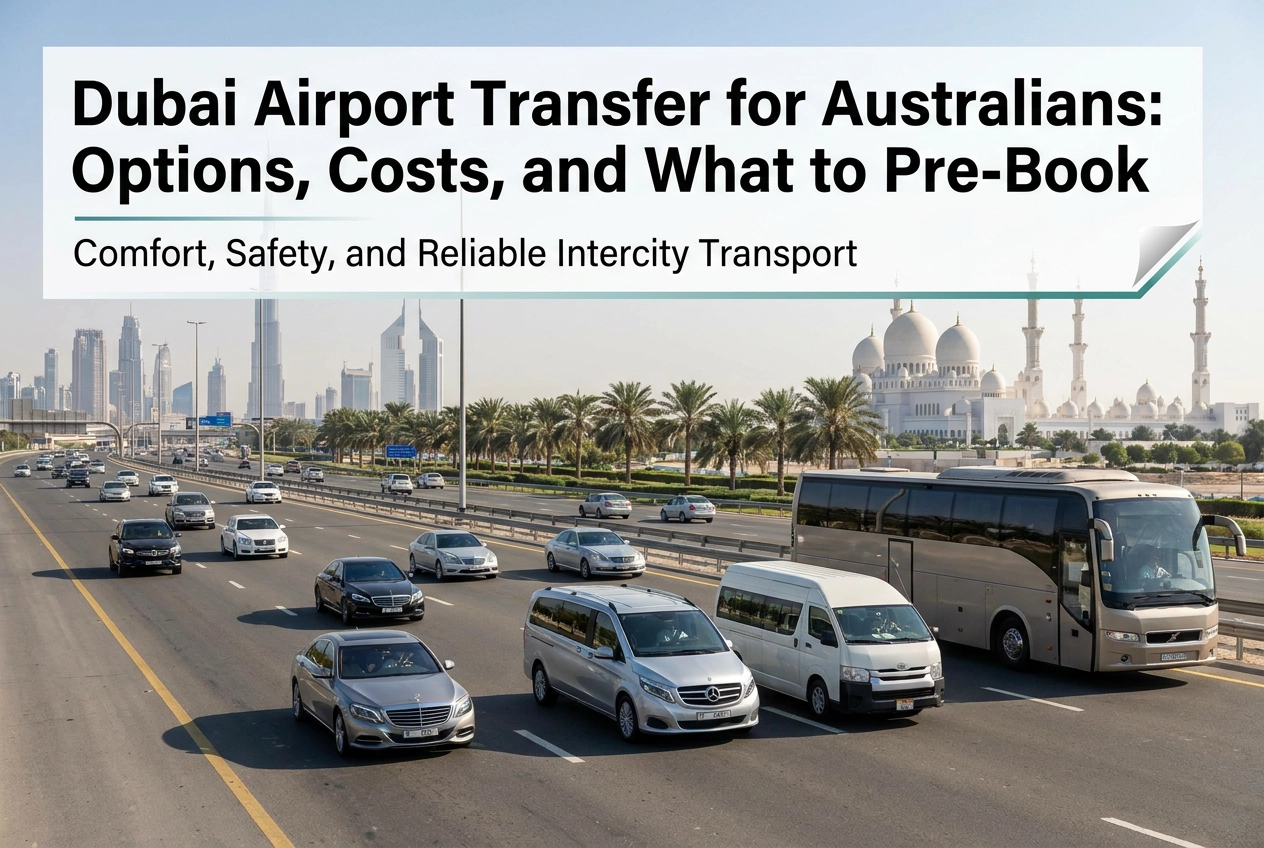

You have just landed at Dubai International Airport after 13-plus hours in the air from Sydney, Melbourne, Brisbane, or Perth. Your body thinks it is 3am, your legs feel like concrete, and you are now standing in one of the busiest transit hubs on the planet trying to figure out how to get to your hotel. Sound familiar?
Getting your Dubai airport transfer sorted before you leave Australia is one of the simplest ways to start your trip on the right foot, and yet most first-time visitors only think about it after they have already joined a slow-moving taxi queue.
This guide is written specifically for Australians arriving at DXB, and it covers everything you actually need to know. You will learn how to read the terminal layout, what every transfer option costs and how long each one takes, when a pre-booked private transfer genuinely pays for itself, and how to lock everything in before your flight departs. By the end, you will have a clear, confident answer on exactly what to book and when.
What Landing at DXB Actually Feels Like After a 13-Hour Flight from Australia
Picture this: you’ve just spent somewhere between 13 and 17 hours in the air, depending on whether you flew out of Sydney, Melbourne, Brisbane, or Perth. Your body clock is convinced it’s somewhere around 3am even if Dubai’s arrivals hall is blazing with mid-morning light. That disorientation is not just uncomfortable; it has a measurable effect on how well your brain works.
Research published by the National Institutes of Health confirms that sleep deprivation impairs attention, working memory, and decision-making. Comparing transfer prices, reading an unfamiliar map, and negotiating a busy kerbside queue all qualify as demanding tasks. You will be doing all three at once, in a new country, after one of the longest commercial flight corridors in regular use.
The time-zone gap makes this worse. Dubai runs on Gulf Standard Time, which puts it several hours behind eastern Australia, the exact offset varies by Australian state and whether daylight saving is active. Your body is not just tired; it is genuinely confused about when it is.
The good news on arrival is straightforward. At the time of writing, Australian passport holders can obtain a free visa on arrival at Terminal 3; confirm current entry requirements with the Australian Department of Foreign Affairs and Trade (DFAT) before you travel, as visa policies can change.
What you cannot automate away is the transport decision waiting for you on the other side of customs. And this is where the fatigue framing matters. From a well-rested desk in Australia, choosing between a taxi, the metro, a ride-hailing app, and a pre-booked transfer feels like a five-minute research task. At DXB after an overnight flight, that same decision carries real cognitive weight.
Knowing a named driver is already holding a sign with your name on it removes that decision entirely. It is already made. You just walk toward the sign.
That is the honest case for thinking about your transport options to Dubai before you leave home, not after you land.
Terminal 3, Pickup Zones, and the DXB vs. DWC Confusion Every Budget Traveller Should Know
Once you know that landing at DXB is its own kind of sensory event, the next thing worth sorting out is exactly where you are within it, and whether you are even at the right airport.
DXB has three terminals. Terminal 1 handles most international carriers that are not Emirates. Terminal 2 is used by smaller regional operators. Terminal 3 is exclusively Emirates, which means almost every Australian arriving on Emirates or a Qantas codeshare on an EK-designated flight walks off the plane into Terminal 3. Terminal assignments can change; always verify your specific carrier’s terminal with the airline directly or via the official Dubai Airports website before confirming any transfer booking.
The separate airport problem. DXB is not Dubai’s only airport. Al Maktoum International Airport (DWC) sits south of the city, further from Downtown Dubai than DXB. Low-cost carriers including Flydubai and Air Arabia increasingly operate from DWC. Terminal assignments can change; always verify your specific carrier’s terminal with the airline directly or via the official Dubai Airports website before confirming any transfer booking. If a pre-booked driver is waiting at DXB and you land at DWC, or vice versa, the cost and time consequences are immediate and significant. Always confirm which airport your flight uses before confirming any transfer booking.
Inside Terminal 3 arrivals. After clearing immigration and collecting bags, you exit into a concourse where taxi ranks, metro access, and private transfer meet-and-greet zones are all present but physically separate. The private transfer zone is inside the arrivals hall itself, where drivers wait with name signs. The taxi rank is outside, at the kerbside queuing area. Knowing which one you are heading for before you walk out saves you from doubling back with a trolley full of luggage.
A quick flight code check before you book anything. Emirates flight numbers start with EK and Emirates operates from Terminal 3. Qantas frequently codeshares on Emirates-designated flights, if your Qantas ticket shows an EK flight number, expect Terminal 3, but confirm with Qantas directly if in doubt. If your ticket shows any other prefix, verify your terminal directly with the airline before providing a pickup location to any transfer provider. It takes two minutes and prevents a genuinely disruptive mistake at the other end.
Every Dubai Airport Transfer Option Compared: Cost, Wait Time, and Effort
Once you know which terminal you’re walking out of, the next question hits fast: how do you actually get to your hotel?
There are four realistic options for the standard Australian arrival at DXB, and they are not equally suitable for every traveller.
| Option | Cost to Downtown | Wait/Effort | Luggage | Surge Risk |
|---|---|---|---|---|
| Metro Red Line | AED 5–7 | Low wait, moderate effort | 1 carry-on max | None |
| Government Taxi | AED 50–80 | Short queue | Good | None |
| Careem / Uber | Variable | App-dependent | Good | Yes |
| Pre-booked Transfer | Fixed price | Zero wait | Excellent | None |
Metro Red Line is the cheapest option by a significant margin. The Red Line connects directly to DXB terminals and reaches Downtown Dubai in roughly 30 to 35 minutes for around AED 5 to 7. That is genuinely impressive value, but it comes with a hard constraint: it is not practical with more than one carry-on bag per person, and if your accommodation sits off the Red Line route, you will need a second transfer anyway.
Government-regulated taxis are the cream-coloured vehicles you will see queued at the kerbside. They run on a metered system with GPS and camera monitoring, making them reliable and fully regulated. The fare to Downtown Dubai typically sits at AED 50 to 80 depending on traffic. Expat communities consistently rate these as the best-value spontaneous option at DXB, and the queue usually moves faster than it looks.
Careem and Uber both operate at DXB, but surge pricing during peak arrival windows makes costs unpredictable. For longer routes like DXB to Abu Dhabi, ride-hailing fares can reach AED 280 to 350, compared to a fixed AED 250 to 300 by metered taxi. The savings over a taxi can evaporate quickly at 6am on a Friday.
Pre-booked private transfers sit at the top on cost, but offer something the other three cannot: certainty before you land. Fixed pricing, a named driver holding your sign in the arrivals hall, typically complimentary waiting time for delays (confirm the exact waiting period when you book), and luggage assistance are all included. If you need a larger vehicle for a group or family, those can be confirmed and priced before you leave Australia.
What a Pre-Booked Private Transfer Actually Includes at Dubai Airport
So you have seen how the four options compare on cost and effort. The next question is a practical one: when you choose pre-booked, what exactly are you paying for?
Here is what a reputable airport transfer dubai service includes as standard.
Flight tracking with automatic driver notification. Your driver is linked to your flight number, not just your scheduled arrival time. If your Emirates departure from Sydney or Melbourne is delayed, the system updates the pickup time automatically. You do not need to make a call from the aircraft or send a message mid-flight.
Meet-and-greet in the arrivals hall. After clearing customs at Terminal 3, your driver is already standing in the arrivals hall holding a sign with your name. No searching for a rank, no downloading an app on roaming data, no explaining your hotel address to a stranger at the kerb. The Dubai Airport Transfer Service Your Trusted Travel Partner model is built around this single point of contact, and it matters most precisely when you are too tired to improvise.
Complimentary waiting time. Most reputable providers hold the booking for a set period after your scheduled landing time, confirm the exact waiting period when you book. That buffer absorbs the realistic variation from immigration queues, baggage reclaim delays, and the long walk through Terminal 3 without any extra charge.
Fixed pricing confirmed before travel. You know the exact AED cost when you book, and you can convert it to AUD using Wise or Google before your flight departs. There is no meter running, no surge variable, and no surprise at the end of the journey.
Luggage assistance. The driver loads and unloads your bags. For Australians arriving with full checked luggage after a 13-plus hour flight, this is a small inclusion that removes a genuinely awkward task.
Driver contact details before arrival. Reputable providers will typically send driver contact details in the 24 hours before your flight, confirm this is part of the service when you book. You can confirm your flight number from the departure lounge and arrive knowing the booking is live and accurate.
Real Transfer Costs from Dubai Airport: Downtown to Abu Dhabi and Beyond
So you know what’s included with a pre-booked transfer. Now let’s talk numbers, because the price gap between options shifts considerably depending on where you’re headed.
Dubai Downtown and Marina are the most common first stops. A metered government taxi runs AED 50 to 80, and a pre-booked sedan sits in a comparable range, though with fixed pricing locked in before you land, no surge risk, and the meet-and-greet already covered in that cost.
The Abu Dhabi route is where the comparison gets interesting. The journey takes anywhere from 1 hour 20 minutes to 2 hours depending on traffic. Here’s how the options stack up:
| Option | Cost (AED) | Notes |
|---|---|---|
| Metered taxi | 250 to 300 | Reliable but no waiting guarantee |
| Careem or Uber | 280 to 350 | Surge pricing applies |
| Economy ride-hailing (e.g. Kiwitaxi) | ~300 | Sits between taxi and sedan on price |
| Pre-booked sedan (up to 4 pax) | 400 to 450 | Fixed price, named driver, waiting included |
| Pre-booked minivan (up to 7 pax) | 700 | Best for families with luggage |
| Pre-booked minibus (up to 12 pax) | ~780 | Groups pay AED 65 per head |
For a deeper breakdown of every inter-emirate option, Dubai to Abu Dhabi Transport: Every Option Compared covers the full picture beyond airport transfers.
The group ROI calculation changes everything. A family of four paying AED 450 for a pre-booked sedan to Abu Dhabi works out to roughly AED 112 per person. That’s comparable to what a solo passenger pays by metered taxi, except a standard taxi cannot comfortably fit four adults with checked luggage. Two taxis immediately doubles the spontaneous cost.
On payment, most pre-booked transfer operators accept Visa and Mastercard, confirm payment methods at the time of booking. This makes it easy to calculate the AUD equivalent via Wise or Revolut before you confirm. Taxis at DXB increasingly accept card payment; carry AED 100 to 200 in cash as a backup in case of terminal issues.
Families, Tour Groups, and Multi-Emirate Itineraries: When Pre-Booking Makes the Most Sense
The per-person maths above shifts further once you factor in what a standard taxi can actually hold.
A standard Dubai taxi is typically sized for up to four passengers with manageable luggage (confirm capacity with the operator). Add a pram, two checked bags each, and a carry-on per person, and you are realistically looking at two taxis. That immediately doubles the spontaneous cost and creates a coordination headache at 6am after an overnight flight: which taxi goes first, who has the car seat, and what happens if one driver takes a different route?
Pre-booking solves this before you land. Vehicles can be sized to your group at the time of booking: sedans for up to four passengers, minivans for up to seven, and minibuses for up to 12 passengers for larger groups or tours. The price is confirmed in advance, so there is no kerbside arithmetic required.
Many Australian travellers also use Dubai as a hub for a wider UAE itinerary: Abu Dhabi for a couple of days, Sharjah for shopping, Fujairah for the coast, Ras Al Khaimah for adventure activities. Each of those inter-emirate legs is a separate transfer, and each benefits from being pre-booked independently. Prices for inter-emirate routes are quoted separately from the airport pickup, so you can plan the full ground transport budget before leaving Australia.
For families travelling with young children, one additional step matters: confirm child seat requirements at the time of booking. A pre-booked provider can arrange this in advance. Standard metered taxis and ride-hailing apps in Dubai do not routinely offer child seats, check availability directly with the provider before relying on this for travel with young children.
The simplest argument for pre-booking a family transfer is this: one driver, one vehicle, one bill, one name sign in the arrivals hall. After 14 hours in the air with children and luggage, that simplicity is worth a great deal.
The Honest Case for Taxis and the Metro: When They Are the Right Call
Not every traveller arriving at DXB needs a pre-booked transfer, and this piece won’t pretend otherwise.
The taxi rank can look intimidating from the back of the queue, but Australians living in Dubai are consistent on this point: it moves faster than it looks. Government taxis operate under a regulated metering system and are GPS-monitored and camera-equipped. For an off-peak arrival, say a mid-morning Tuesday, queuing for a government taxi is a perfectly rational call for a solo traveller with a single carry-on heading to a central hotel.
The Metro is even cheaper when the conditions align: it works well for minimal luggage and accommodation near a Red Line station, but add a checked bag per person or a hotel off the line, and the logic breaks down quickly.
Ride-hailing via Careem suits spontaneous bookers who are comfortable with variable pricing. It works smoothly during quieter periods, and Careem has strong penetration in the UAE market with an interface that visitors find easy to navigate. The risk is surge pricing during peak arrival windows, which can push fares well above the metered taxi equivalent with no warning.
The honest framing is this: taxis and the Metro are rational under a specific set of conditions, namely solo travel, minimal luggage, off-peak arrival, and accommodation near the Red Line. The case for pre-booking strengthens with each variable you add. More passengers, more bags, an early-morning arrival, a tight itinerary, or a first-time visit to DXB each shift the calculation.
If you are already considering whether to rent a car in Dubai for part of your trip, it is worth noting that the airport transfer and the car rental are separate decisions; sorting the transfer first removes one variable from an already busy arrival.
This piece is not arguing that taxis are a bad choice. It is arguing that the conditions where a pre-booked transfer genuinely pays for itself are more common than most Australians expect before they land.
How to Pre-Book a Dubai Airport Transfer Before You Leave Australia
Once you’ve decided a pre-booked transfer suits your trip, the actual booking process takes about ten minutes from your couch in Australia. Here’s how to do it properly.
Confirm your terminal first. Emirates flight numbers start with EK and Emirates operates from Terminal 3 at DXB. Qantas frequently codeshares on Emirates-designated flights, if your Qantas ticket shows an EK flight number, expect Terminal 3, but confirm with Qantas directly if in doubt. If you’re on a budget carrier or a regional connecting flight, check your ticket explicitly; arriving at the wrong terminal when a driver is waiting at another adds time and cost you don’t want.
Match the vehicle to your group before comparing prices. A sedan quoted at AED 400 for four passengers works out to roughly AED 100 per head. Comparing that to a solo taxi fare is the wrong calculation. Decide on your vehicle category first, sedan, minivan, or minibus, then look at the per-person cost.
Only book with a provider that explicitly includes flight tracking and a named meet-and-greet. These two features are the entire point of pre-booking: you walk out of customs and go directly to a person, regardless of any delay. Don’t assume these are included; confirm them before paying.
Check the waiting time policy. Terminal 3 immigration and baggage reclaim can absorb 30 to 45 minutes on a busy morning. Most reputable providers offer a period of complimentary waiting after your scheduled landing time, confirm the exact waiting period when you book. That buffer is what separates a relaxed arrival from a stressful one.
Save the driver’s contact details before you board in Australia. Reputable providers will typically send these in the 24 hours before your flight, confirm this is part of the service when you book. Screenshot the details or save them to your contacts while you still have reliable Wi-Fi, so you can reach your driver without hunting through emails after landing.
GetRide’s Dubai airport transfer service covers DXB arrivals with flight tracking, arrivals-hall meet-and-greet, fixed pricing, and routes across Dubai, Abu Dhabi, Sharjah, Ras Al Khaimah, Fujairah, and Hatta. It’s worth confirming your booking at the same time you lock in your flights.
Book early. During Australian school holidays, UAE public holidays, and major Dubai events, vehicle availability tightens quickly. A 48 to 72-hour lead time is the minimum; booking when you confirm your flights is better and costs nothing extra.
Paying for Your Dubai Airport Transfer: Cards, Cash, and AUD-to-AED Conversion
Once your booking is confirmed, the payment side of things is simpler than most Australians expect.
Pre-booked transfers: most operators accept Visa and Mastercard, confirm payment methods at the time of booking. Because the price is quoted in AED and fixed upfront, you can check the AUD equivalent instantly using Google or Wise before you confirm. No surprises at the other end.
Government taxis at DXB: card payment is increasingly available; carry AED 100 to 200 in cash as a backup in case of terminal issues. Tolls are sometimes cash-only, and having a small float means a technical hiccup does not become a problem at midnight after a 14-hour flight.
On currency conversion: currency conversion at Australian airport bureaux de change typically carries a higher spread than alternatives, consider loading AED onto a Wise or Revolut card before you leave, or withdrawing AED from an ATM inside DXB arrivals once you land. Either approach gives you a significantly better rate than an airport counter conversion.
If you are using Careem or Uber, the fare is charged in AED to whichever card is registered in the app, and the final total only appears after the journey completes. Before you confirm a booking, use the in-app fare estimate. It takes ten seconds and removes the guesswork entirely, particularly during peak arrival windows when surge pricing can push fares well above the base rate.
Tipping is not obligatory in Dubai, though it is appreciated; rounding up a fare or offering a small gratuity for luggage assistance is common practice among regular visitors. It is a gesture, not an obligation.
Finally, if you use a travel money card or multi-currency account, confirm AED is a supported currency before you depart. Some cards exclude it or charge a conversion fee on AED transactions. A quick check with your card provider before you fly saves an awkward moment at the payment terminal.
The Straight Answer: What to Book Before Your Flight Departs Australia
Once you have sorted your payment method, the only question left is what to actually book.
Solo traveller, minimal luggage, arriving off-peak? The government taxi or Dubai Metro is a perfectly legitimate call, regulated, reliable, and cheap.
Family, group, or anyone hauling checked bags off a 14-hour overnight flight? Pre-book a private transfer. One name sign, one driver, one fixed price confirmed before you board in Sydney or Melbourne. That single decision removes the biggest friction point from your entire arrival.
When you do pre-book, run through the checklist from the How to Pre-Book section above: confirm your terminal, match your vehicle to your actual headcount and luggage, and verify that your provider includes flight tracking, arrivals-hall meet-and-greet, and adequate complimentary waiting time.
Book before you leave Australia. Availability tightens around school holidays, UAE public holidays, and major Dubai events. More importantly, the mental cost of figuring this out after 14 hours in the air is genuinely not worth whatever you might save by leaving it until the gate.
GetRide (Royal Plus Transport) offers pre-booked airport transfers across the UAE, including Dubai, Abu Dhabi, Sharjah, Ras Al Khaimah, Fujairah, and Hatta, with fixed pricing and online booking. It is worth locking in at the same time you confirm your accommodation, so your ground transport is simply one less thing on the list when you land.
Conclusion
Dubai arrivals do not need to be complicated. The metro is cheap and works well for solo travellers travelling light. Taxis are reliable and readily available at Terminal 3. And for families, groups, or anyone stepping off a long-haul overnight flight with checked luggage and tired kids, a pre-booked private transfer is simply the smarter call.
The three things worth remembering: confirm your terminal before booking, match your vehicle to your actual group size, and only book with a provider that includes flight tracking, meet-and-greet, and adequate waiting time.
Do not leave this decision until you land. Book your Dubai airport transfer before you leave Australia, at the same time you lock in your hotel. GetRide (Royal Plus Transport) offers fixed-price, pre-bookable transfers across the UAE. Sorted before you board means one less thing to think about when you finally touch down.