

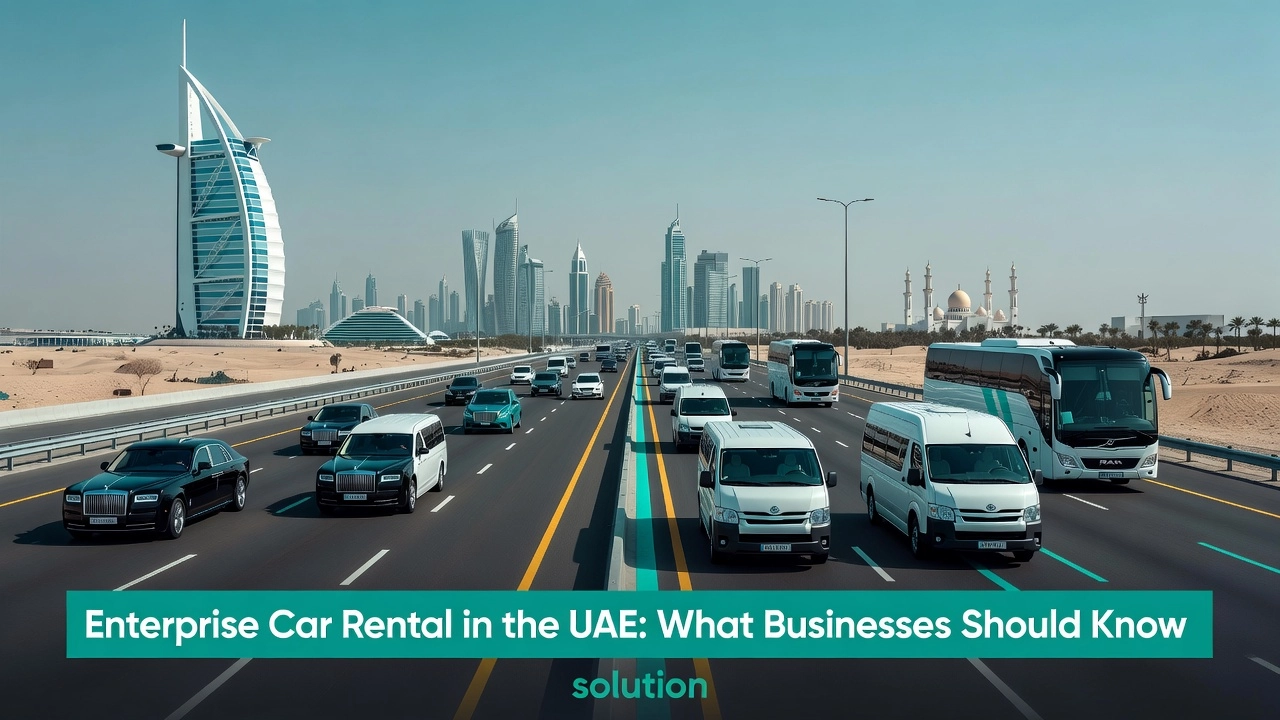

Managing business travel and corporate mobility in the UAE is no small feat. With a fast-moving economy, multiple business hubs, and a constant flow of executives, clients, and teams on the move, having a reliable vehicle solution is essential. That is where enterprise car rental becomes a critical conversation for any business operating in the region.
But not all rental solutions are created equal. Whether you are comparing providers, evaluating long-term contracts, or simply trying to understand what separates a corporate-grade rental experience from a standard one, the options available in the UAE can feel overwhelming at first glance.
This post breaks it all down for you. We will walk through the key factors businesses should consider when choosing an enterprise car rental provider in the UAE, compare what leading services typically offer, and highlight the practical details that often get overlooked. By the end, you will have a clearer picture of which rental approach best fits your company’s needs, budget, and operational demands. If corporate mobility matters to your business, this guide is worth your time.
What Does ‘Enterprise Car Rental’ Actually Mean?
When most people search for “enterprise car rental,” they are thinking of one of two very different things: a globally recognised brand, or a category of business-grade transport services. Understanding the distinction matters, especially if your organisation is evaluating transport solutions in the UAE.
The brand is one participant in an industry valued at approximately USD 103.4 billion in 2025, projected to exceed USD 191.4 billion by 2035. As a category, enterprise or corporate car rental refers to structured transport arrangements made by businesses for staff, executives, clients, or events. These arrangements are typically governed by a service-level agreement rather than a casual, walk-up booking. Demand is driven by growth in business travel, rising urbanisation across Gulf cities, and the increasing preference for managed, on-demand mobility solutions.
Within the UAE specifically, corporate transport operates across two formally recognised models: self-driven fleet rental, where vehicles are leased without drivers and often structured as long-term contracts, and chauffeur-driven services, where professional drivers are included as part of the arrangement. The latter is a mainstream enterprise sub-segment, not a niche offering.
For procurement teams, the difference carries significant operational weight. Chauffeur-driven corporate transport transfers liability for the driver, vehicle roadworthiness, and insurance directly to the service provider. It removes the administrative burden of verifying employee licences and issuing internal driving authorisations. It also delivers predictable costs through managed accounts with agreed service terms.
This guide focuses on corporate transport providers operating across the UAE, with particular attention to chauffeur-driven services, staff shuttle operations, and structured corporate accounts covering cities including Dubai, Abu Dhabi, Sharjah, Al Ain, Ras Al Khaimah, and Fujairah.
The UAE Corporate Car Rental Market at a Glance
The global car rental industry is expanding at a pace that reflects how fundamentally business travel has changed. The enterprise-focused segment of that market was valued at USD 80 billion in 2024 and is projected to reach USD 130 billion by 2033, growing at a 5.4% CAGR through the forecast period, according to enterprise car rental market analysis covering 2026–2033. At the broader market level, global car rental revenues are forecast to nearly double within a decade, confirming that demand for structured, business-grade transport is accelerating rather than softening.
Within this global picture, the UAE and wider Middle East operate as a distinct, high-opportunity sub-market with its own competitive dynamics and growth trajectory. Unlike the Asia Pacific region, which leads on raw volume and growth velocity, the Middle East commands dedicated competitive forecasting precisely because its B2B corporate transport activity is rising on a separate curve. Factors such as large multinational workforces, inter-emirate business travel, and government-led economic diversification initiatives all contribute to sustained corporate mobility demand across Dubai, Abu Dhabi, Sharjah, and beyond. The Middle East car rental market is formally tracked as an independent segment with competitive intelligence extending through 2031, signalling meaningful institutional interest from both investors and procurement teams.
Corporate buyers evaluating transport solutions in the UAE will encounter a market segmented across four practical dimensions: rental duration (short-term versus long-term contracts), booking type (online self-service versus managed offline accounts), driving arrangement (self-driven versus chauffeur-driven), and vehicle category (economy versus premium or luxury). Each dimension represents a different procurement decision with distinct cost, compliance, and operational implications. A logistics firm managing daily staff movement across three emirates, for example, will evaluate these axes very differently from a professional services firm sourcing executive transfers for client visits.
As of mid-2026, strategic partnership formation has emerged as the dominant commercial mechanism driving growth in the region. Long-term B2B contracts, managed corporate accounts, and integrated fleet agreements are replacing transactional, per-trip booking as the preferred structure for organisations with consistent transport requirements. Three interconnected demand drivers underpin this shift: rising urbanisation across the seven emirates, growing intra-UAE corporate travel, and technology investment in fleet management platforms that give procurement managers real-time visibility over costs, vehicle utilisation, and driver performance. Providers capable of aligning with all three drivers, through modern fleets, account-managed service models, and transparent operations, are best positioned to capture the B2B growth that industry forecasters confirm is the primary engine of the UAE market through 2033.
Global Providers vs. Local UAE Operators: A Practical Comparison
Choosing the right corporate transport provider in the UAE requires more than comparing daily rates. Procurement managers evaluating the market should assess providers across five dimensions that directly affect operational performance: geographic coverage across all seven emirates, chauffeur-driven service availability, corporate account management quality, pricing model transparency, and UAE regulatory compliance. Applying this framework reveals a clear structural divide between global chains and locally embedded operators.
Global Chain Profile
International transport brands carry significant advantages in brand recognition and technology infrastructure. Their digital booking platforms, app-based fleet management tools, and standardised corporate billing systems appeal to multinational procurement teams that manage travel programmes across multiple countries. However, their UAE footprints tend to concentrate around major commercial hubs, with secondary emirates and specialist routes receiving less consistent coverage. Pricing for global chains typically reflects international premium positioning, meaning corporate clients in the UAE often absorb a brand premium that has limited relevance to their actual local operating requirements. Account management through global frameworks is generally standardised, which can reduce the flexibility needed to accommodate route-specific needs, urgent vehicle additions, or negotiated SLA terms outside a preset corporate contract structure.
Local UAE Operator Profile
UAE-based operators like GetRide are structured around the geographic and operational realities of this market. GetRide provides multi-emirate coverage spanning Dubai, Abu Dhabi, Al Ain, Sharjah, Ras Al Khaimah, Fujairah, and Hatta, serving routes that fall entirely outside standard global fleet zones. Corporate account management operates on a relationship-first model, with dedicated contacts who understand the specific requirements of staff transport, corporate shuttles, and daily intercity routes such as Dubai to Abu Dhabi. Drivers are RTA-compliant, which is a non-negotiable requirement for legally operating passenger transport services in Dubai and across the UAE. Pricing is structured around local market rates quoted in AED, removing the currency exposure and international brand premiums that can inflate global chain costs for UAE-based procurement budgets.
Side-by-Side Comparison
| Dimension | Global Chain | GetRide (Local Operator) |
|---|---|---|
| Geographic UAE Coverage | Major hubs; secondary emirates inconsistent | All seven emirates including Al Ain, Fujairah, Hatta |
| Chauffeur-Driven Availability | Select locations; primarily self-drive | Core service offering across all coverage zones |
| Corporate SLA Terms | Standardised global framework | Customised SLAs with dedicated account managers |
| Local RTA Compliance Assurance | Variable by franchise structure | RTA-compliant drivers and vehicles throughout |
| Pricing Model | International premium positioning in USD/global rates | AED-based local market pricing, no brand premium |
| Multi-Emirate Daily Routes | Limited; major hubs prioritised | Daily Dubai to Abu Dhabi service and cross-emirate routes |
For procurement managers, the strategic implication is clear. Global chains deliver value when an organisation needs a unified international travel platform or worldwide brand consistency. Local UAE operators deliver value when the priority is geographic agility, regulatory certainty, and the ability to service routes and schedules that require genuine on-the-ground knowledge. For corporate car rental needs across the UAE, understanding this divide is the foundation of a well-structured transport decision. Organisations with operations distributed across multiple emirates will consistently find that local operators with dedicated multi-emirate infrastructure are better positioned to deliver the coverage and compliance their transport programmes actually require.
Key Factors to Evaluate When Choosing a Corporate Transport Partner
Selecting the right corporate transport partner involves considerably more than reviewing a price list. Procurement teams that apply a structured evaluation framework protect their organisations from service disruptions, compliance exposure, and hidden costs that only surface after a contract is signed.
Fleet Quality and Maintenance Standards
A provider’s fleet condition is one of the most direct indicators of operational reliability. Before committing to any corporate transport agreement, ask specifically about the vehicle age policy, how frequently preventive maintenance is scheduled, and whether each vehicle undergoes a pre-assignment inspection before serving your staff. Older, poorly maintained vehicles create punctuality risks and, more critically, passenger safety concerns that reflect on your organisation. Providers who can produce documented maintenance records and clear fleet renewal timelines demonstrate a level of operational discipline that translates into consistent daily performance.
Multi-Emirate Route Coverage
Corporate operations in the UAE rarely stay confined to a single corridor. Many businesses have sites spanning Dubai, Abu Dhabi, Sharjah, and less-served locations such as Al Ain, Hatta, Fujairah, and Ras Al Khaimah. Confirm that your provider can cover all locations where your teams operate, not just the high-volume intercity routes. GetRide, for example, operates across all seven emirates and maintains dedicated daily services on the Dubai-Abu Dhabi corridor, giving clients a single accountable partner for nationwide requirements.
RTA Compliance and Driver Credentialing
In the UAE, professional transport drivers must hold licensing that meets Roads and Transport Authority standards. Any credible corporate transport partner should be able to verify full driver compliance, appropriate vehicle insurance coverage, and operator licensing without hesitation. Requesting this documentation upfront protects your organisation legally and ensures every journey meets the regulatory baseline the UAE market requires.
SLA Terms and Corporate Accountability
Service-level agreements separate professional transport partners from informal operators. Before signing, request SLA clauses that define on-time performance targets, vehicle substitution protocols when a breakdown occurs, named account management contacts, and billing transparency with itemised reporting. These terms give your finance and operations teams measurable benchmarks to hold providers accountable throughout the contract period.
Digital Booking and Reporting Capabilities
As business car rental platforms increasingly shift toward digital-first models, your transport provider’s technology infrastructure matters as much as its fleet. Evaluate whether the provider offers app-based or portal-based scheduling, real-time vehicle tracking, and usage reporting that can integrate with your internal cost management systems. In 2026, providers who cannot offer these capabilities create unnecessary administrative overhead for corporate clients who expect seamless, data-driven transport management as a standard rather than a premium feature.
Why UAE Businesses Are Shifting to Chauffeur-Driven Corporate Transport
The chauffeur-driven model has moved well beyond its origins as an executive perk. Industry research now formally classifies chauffeur-driven services as a co-equal rental type alongside short-term and long-term self-driven leasing, meaning corporate procurement teams across the UAE are evaluating managed driver contracts on the same framework as traditional fleet arrangements. This shift reflects a broader market reality: the global car rental market is forecast to reach USD 295.9 billion by 2035, driven in significant part by business travel demand and the formalisation of corporate mobility under managed service agreements.
Staff Transport Formalisation Across Emirates
For UAE companies operating across multiple emirates, ad hoc commuting arrangements create measurable HR and compliance risk. Delayed arrivals, unreimbursed private vehicle claims, and the absence of any documented transport record all represent liability gaps that managed chauffeur contracts directly resolve. By consolidating employee transport under a single provider relationship, businesses gain punctuality accountability, journey documentation, and a defensible duty-of-care framework. This is particularly relevant for companies with shift-based workforces in manufacturing, hospitality, healthcare, and facilities management, where transport reliability directly affects operational continuity.
The Dubai to Abu Dhabi Corridor
The inter-emirate commuter route between Dubai and Abu Dhabi is one of the most commercially active transport corridors in the region. Employees making this daily journey by private vehicle carry personal insurance liability, bear fuel and toll costs, and arrive with accumulated fatigue. A managed per-seat or per-vehicle service converts that variable and uncontrolled cost into a predictable line item, removes employer liability, and allows staff to use travel time productively. GetRide operates daily scheduled services on this corridor in both directions, offering corporate accounts a structured and cost-transparent solution.
Local Cost Structure Versus Global Overhead
International transport brands operating in the UAE carry the overhead of global networks, multi-country compliance structures, and premium positioning strategies. Locally embedded providers, operating right-sized fleets within a defined regional geography, can deliver comparable or superior service quality at account rates that reflect actual UAE operating costs rather than global margin requirements. For procurement teams managing monthly transport budgets, that structural cost difference is significant across a full contract term.
A Single Provider for Diverse Corporate Mobility
Beyond daily staff shuttles, a full-service chauffeur provider supports executive airport transfers, client hosting, event logistics, and guided city tours across Dubai, Abu Dhabi, Sharjah, Al Ain, Ras Al Khaimah, Fujairah, and Hatta. Consolidating these requirements under one corporate account simplifies procurement, standardises service expectations, and eliminates the coordination overhead of managing multiple transport vendors for different journey types.
Emerging Trends Shaping Enterprise Car Rental in the UAE Through 2033
The enterprise car rental landscape is shifting faster than many procurement teams have anticipated, and understanding the five structural trends reshaping the market through 2033 is essential for businesses making transport decisions today.
Digital-First Bookings Are Now a Baseline Expectation
Portal-based booking, real-time driver tracking, and digital invoicing have transitioned from premium features to minimum requirements. Corporate clients in the UAE increasingly expect a seamless digital interface for scheduling, modifying, and reconciling transport arrangements without relying on phone calls or manual paperwork. Providers that cannot offer a self-service portal or automated invoice delivery are being filtered out of procurement shortlists at the initial evaluation stage. For HR and operations teams managing large staff transport programmes, the administrative efficiency gained through app-managed fleet scheduling is measurable and significant.
MaaS Integration Is Redefining Transport Procurement
Mobility-as-a-Service platforms are beginning to consolidate ground transport, airport transfers, and shuttle services into a single coordinated interface. Enterprise transport operators are under increasing pressure to connect with multi-modal platforms, giving corporate clients a unified view of all journeys rather than managing separate supplier relationships. This integration trend will reshape how UAE businesses structure their transport contracts through 2033, with providers offering coordinated multi-modal coverage gaining a competitive procurement advantage over single-service operators.
Subscription Models Reduce Budget Volatility
The enterprise car rental market, valued at USD 80 billion in 2024 and forecast to reach USD 130 billion by 2033, is seeing a steady shift away from per-trip pricing toward monthly flat-rate transport packages. Subscription-style agreements give finance teams a predictable cost line and allow HR to plan staff commute budgets without exposure to daily rate fluctuations. Providers offering defined vehicle and driver allocation under a fixed monthly structure are becoming the preferred commercial model for medium and large enterprises.
EV Fleet Adoption Requires Proactive Engagement
The electric car rental sub-segment is projected to grow at a CAGR of 15.40 percent through 2035, nearly three times the pace of the broader market, driven by sustainability mandates and expanding charging infrastructure. UAE corporate clients should begin requesting EV availability information from transport providers now, ahead of regional fleet electrification accelerating. Embedding EV requirements into managed transport contracts positions businesses to meet their sustainability commitments without renegotiating terms mid-contract.
Structured B2B Partnerships Are the Primary Growth Lever
As of July 2026, strategic partnership formation between transport providers and UAE corporates is identified as the primary regional growth mechanism per enterprise car rental market analysis for 2026 through 2033. Businesses that secure structured long-term transport agreements now are positioned to negotiate preferential rates, priority fleet access, and bespoke route coverage before increased demand tightens available capacity. GetRide’s locally embedded operations across Dubai, Abu Dhabi, Sharjah, Al Ain, and the Northern Emirates make structured partnership formation practical and immediately actionable for UAE corporates evaluating their options.
GetRide’s Corporate Transport Solutions Across the UAE
GetRide operates as a single-provider corporate transport solution across all seven UAE emirates, removing the operational complexity that comes with managing multiple transport vendors. The service portfolio spans staff transportation, corporate shuttle services, school transport, event transportation, chauffeur-driven car rental, and airport transfers, giving procurement managers a unified account structure that covers virtually every passenger movement requirement a business generates.
Coverage That International Chains Rarely Match
Geographic reach is where GetRide establishes a clear structural advantage over providers operating from a limited number of city locations. GetRide services Dubai, Abu Dhabi, Al Ain, Sharjah, Ras Al Khaimah, Fujairah, and Hatta, including scheduled daily intercity routes on the high-demand Dubai to Abu Dhabi corridor. For organisations with operations distributed across multiple emirates, this depth of local coverage translates directly into fewer supplier relationships, consolidated invoicing, and more consistent service quality across all routes.
Fleet, Drivers, and Compliance Standards
Every vehicle in the GetRide fleet is maintained under a regular maintenance programme, ensuring operational reliability and minimising the risk of service disruption. Drivers are professionally experienced, punctual, and operate in full compliance with UAE transport standards, providing the accountability framework that enterprise clients require when passenger safety and schedule adherence are non-negotiable.
Corporate Account Structure and How to Engage
GetRide is built for long-term B2B relationships rather than transactional bookings. The corporate account model includes customised travel solutions, transparent billing, and dedicated account management, aligning with how enterprise procurement teams prefer to structure and monitor transport spend. Corporate buyers can contact GetRide directly to discuss route requirements, fleet specifications, SLA terms, and pricing, making it straightforward to receive a tailored quote without being constrained by a standardised global package.
Choosing the Right Enterprise Car Rental Partner in the UAE
Selecting the right corporate transport partner comes down to five criteria that matter more than brand recognition: UAE geographic coverage, chauffeur-driven capability, RTA compliance management, SLA transparency, and a pricing model that reflects your actual usage patterns. Businesses that evaluate providers on these operational dimensions consistently make better long-term decisions than those that default to familiar names.
For companies operating across multiple emirates, the local advantage is significant and practical. A provider with embedded multi-emirate route knowledge, dedicated account management, and regulatory familiarity handles daily operational friction in ways that standardised international chains are simply not structured to do. Relationship-based account management means escalations are resolved faster, route adjustments are made without bureaucratic delays, and contract terms can flex as your business evolves.
The market itself is shifting in ways that make provider agility a strategic consideration. Subscription-based models, digital fleet management tools, and EV integration are all reshaping enterprise transport through 2033. Locking into a rigid legacy contract today may limit your options as these structures become standard. Providers that are open to evolving contract frameworks will deliver stronger value over a multi-year horizon.
The practical next step is straightforward: audit your current transport spend, map the emirates and corridors your teams use regularly, and use those specific criteria to shortlist two or three providers. Request a formal corporate quote from each before committing.
GetRide is available to discuss corporate transport requirements across all UAE emirates, from daily staff shuttles to executive transfers. Contact the team to request a tailored corporate transport quote and explore how a managed account can be structured around your business needs.
Conclusion
Choosing the right enterprise car rental solution in the UAE is not just a logistical decision; it is a strategic one. The key takeaways are clear: prioritize providers that offer flexible contract terms, a well-maintained and diverse fleet, dedicated corporate support, and transparent pricing with no hidden costs. These factors separate a rental partner that genuinely supports your business from one that simply hands over keys.
The UAE’s business landscape moves fast, and your mobility solution should keep pace. A reliable rental partner reduces operational friction, supports your team’s productivity, and reflects positively on your brand when transporting clients and executives.
Now is the time to evaluate your current setup. Request quotes, compare service levels, and ask the hard questions before signing anything. The right enterprise car rental partnership is out there, and it can make a measurable difference for your business.